
Last updated:
Most dog GPS trackers claim pinpoint accuracy, but real-world results vary. Here’s the honest breakdown of GPS accuracy, update frequency, and what actually affects it.
Every GPS tracker brand advertises accuracy, but the actual numbers and what affects them rarely get explained clearly. If your dog is genuinely missing, the difference between a tracker that’s accurate to 10 feet versus one that’s off by 200 feet is the difference between finding them in minutes versus searching an entire neighborhood block by block.
Let’s break down what “accuracy” actually means for these devices, what real-world factors affect it, and how to set realistic expectations before you’re relying on it in an actual emergency.

The Honest Baseline Number
Under good conditions, most GPS pet trackers are accurate to within 10 to 30 feet (roughly 3 to 10 meters) of your dog’s actual location. This is a genuinely useful range for most real-world scenarios, close enough to spot your dog visually once you’re in the right area, but it’s important to understand this number is a best-case figure, not a guarantee.
How GPS Accuracy Actually Works
A GPS tracker calculates its position by receiving signals from multiple satellites and measuring how long each signal takes to arrive. The more satellites it can lock onto clearly, the more precise the resulting location. This is why accuracy isn’t a fixed number, it genuinely changes based on conditions in real time.
What Actually Affects Real-World Accuracy
Several everyday factors push accuracy up or down, often within the same walk:
- Open sky versus obstructions. Accuracy is best in open areas. Tall buildings, dense trees and steep valleys can block or bounce satellite signals.
- Indoors. GPS signals are weak inside buildings, so many trackers rely on Wi-Fi or Bluetooth to know your dog is home rather than a precise GPS fix.
- Number of satellite systems. Trackers that use several systems (such as GPS, GLONASS and Galileo) can usually find more satellites and hold a steadier position.
- Cellular signal. A tracker can know exactly where your dog is and still fail to send it to your phone if there is no cell coverage.
- Update mode. Power-saving modes update less often, so the location you see may be several minutes old unless you switch to live tracking.
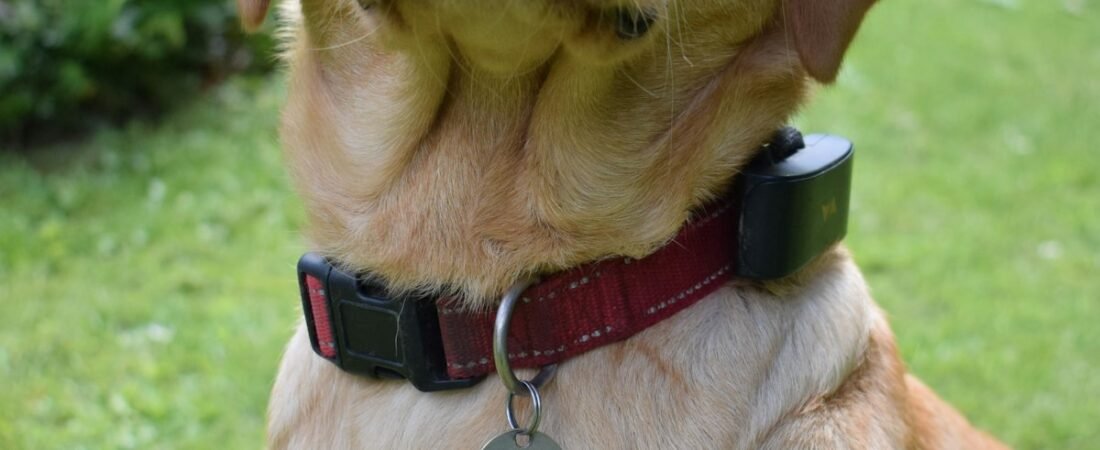
- How the tracker sits on the collar. A tracker that rotates under the neck or is covered by thick fur may get a weaker signal.

Update Frequency: The Factor Most Reviews Skip
Accuracy in feet only tells half the story. How often a tracker actually refreshes that location matters just as much, especially for a dog that’s actively moving. Update intervals vary significantly between brands and modes, generally ranging from near-continuous updates every few seconds in an active “live tracking” mode, down to roughly once a minute in standard battery-saving mode. A tracker that’s accurate to 10 feet but only updates once a minute can still show your dog well behind where they actually are if they’re moving quickly.
This is exactly why a dedicated “Lost Dog Mode” or live tracking feature matters so much in an actual emergency, it temporarily switches to much more frequent updates specifically when you need precision most, rather than running down the battery with constant high-frequency updates all the time.
Setting Realistic Expectations
It’s worth being honest here: some real-world user reports describe accuracy occasionally being off by significantly more than the advertised spec, sometimes by a hundred feet or more, particularly in challenging environments. This doesn’t necessarily mean a device is defective, GPS technology has genuine physical limitations that no brand can fully engineer around. The practical takeaway is to treat any tracker’s live location as a strong starting point to narrow your search, not an exact pin you can walk directly to with certainty every time.
We’ve found Tractive’s multi-network cellular switching and the Fi Series 3+’s dedicated Lost Dog Mode both meaningfully improve real-world reliability specifically during an active search, compared to relying on standard update intervals alone.
Frequently Asked Questions
❓ How accurate are dog GPS trackers in feet?
Most dog GPS trackers are accurate to within 10 to 30 feet under good conditions, though this can vary based on signal obstruction, urban environments, and the device’s specific update settings.
❓ Why does my tracker’s location sometimes seem wrong?
This is usually caused by signal obstruction from buildings, dense tree cover, or the device being in a battery-saving mode with less frequent updates, rather than a defect in the device itself.
❓ Does update frequency matter more than accuracy in feet?
For an actively moving dog, yes, arguably just as much, since a highly accurate reading that only refreshes once a minute can still show an outdated position well behind where your dog currently is.
❓ Do GPS trackers work accurately in cities?
Accuracy can be reduced in dense urban areas due to the “urban canyon” effect, where signals bounce off tall buildings, though trackers using multiple satellite systems or cellular triangulation together generally perform more reliably in these conditions.
Related Articles


This post may contain affiliate links. If you purchase through one of these links, we may earn a small commission at no extra cost to you.
Looking to compare devices side-by-side? Browse all the GPS dog trackers we cover and compare specs →
Check the latest price on Amazon
As an Amazon Associate we earn from qualifying purchases.
Check Price on Amazon →SmartPetPick Team
The SmartPetPick Team researches and compares GPS dog trackers, smart collars, and pet safety technology. We dig into manufacturer specs, subscription pricing, independent reviews, and real owner feedback so US dog owners can choose with confidence.